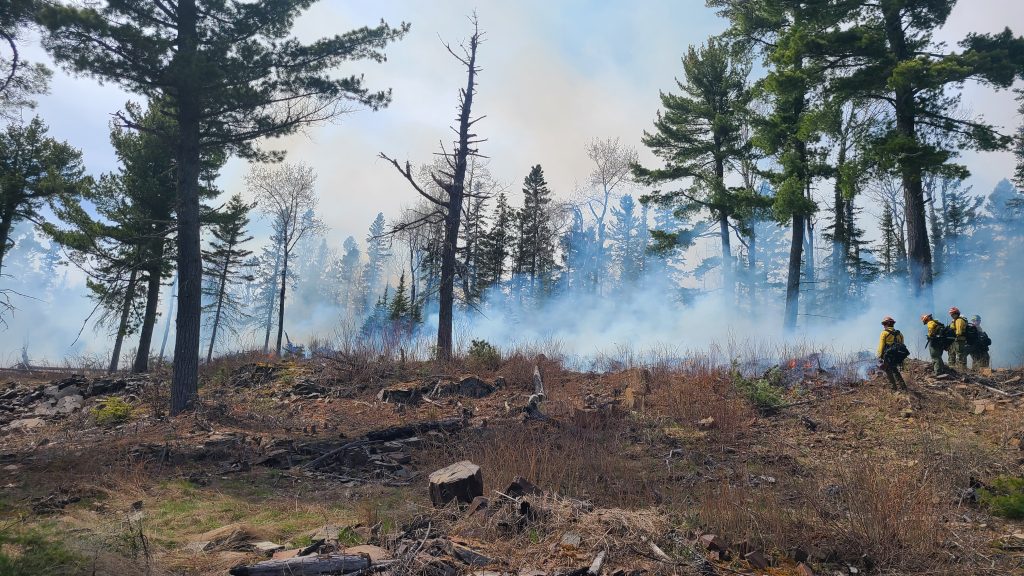
In mid-July, wildfire smoke hung heavily over Grand Portage. Familiar views disappeared into the haze, residents were advised to stay indoors, and local air-quality readings climbed far beyond the standard index.
While the wildfires burning across northeastern Minnesota are not directly threatening the Reservation, the Grand Portage Band is an essential part of the response. The Band is protecting the community at home while contributing resources, local knowledge, cultural guidance and planning support across the region.
Protecting the Reservation
Grand Portage firefighters are accustomed to going where they are needed, traveling across Minnesota and throughout the country for wildfire assignments. This season placed the crew in a less familiar position: needing to stay closer to home.
While fires were burning elsewhere in the region, Grand Portage was experiencing some of the highest fire-danger indices in Minnesota. Widespread fire activity across the country also meant outside resources were already limited.
Tim Miller, who administers the Grand Portage fire program, said the Band had to balance supporting nearby incidents with maintaining enough experience and equipment to protect the Reservation.
“Our guys go all over the country, but it was always when we had enough resources here at home,” Miller said. “This is a little different situation. We’re trying to make decisions about letting people go to other events versus staying in Grand Portage, and making sure that if we get a fire, we can handle it.”
Four Grand Portage firefighters assisted with the Long Two Fire, the Airport Pit Fire and the Sunfish prescribed burn after it became active again during the extreme conditions. Grand Portage also brought in two experienced firefighters from White Earth, giving the Band more flexibility to help nearby while keeping qualified personnel close to home.
The Band’s response area includes the Reservation and an established buffer area where crews can respond automatically. During the period of highest risk, firefighters worked longer shifts, increased patrols and kept multiple engines staffed. When lightning-strike maps became available, crews tried to check each location for signs of ignition.
“We actually try to get boots on the ground at each lightning-strike spot, to take a look and verify there has not been an ignition,” said Erik Carlson, Lead Fire Technician.
Rain eventually provided some relief and a much-needed opportunity to rest after a season that had already included prescribed burning, assignments at other reservations and heightened preparedness at home.
“It’s been a long season already,” Carlson said. “We’ve just been going and going, and now we’re focusing on mitigating fatigue. It’s still going to be a long season.”
The area remains six to seven inches below its normal rainfall, and fire danger can continue well into the fall.
“The potential to get back to high fire danger exists,” Carlson said. “We can’t let our guard down, but we can let our guys go take a break.”
Supporting the Regional Response
Grand Portage’s role extends beyond the fireline. Tribal staff and leadership have participated in daily briefings, public-information meetings and strategic planning with the National Incident Management Organization (NIMO), the Superior National Forest, Cook County and other regional partners.
As a wildfire grows, a national incident management team often takes responsibility for specialized operations and planning. Band representatives remain closely involved in this broader response.
“We make sure that we’re getting our local perspective involved in their planning,” said Grand Portage Emergency Manager Ruth Vogel.
The response includes several overlapping jurisdictions and interests. The fires are burning on federal land within the 1854 ceded territory, with federal, state, county and Tribal interests all involved.
“We’re all players at the table,” Vogel said. “So far it has gone really well, where I think all the entities are being very respectful of each other and making sure everybody gets to say their piece.”
Long-standing relationships have made that coordination easier. Grand Portage has an established agreement with the Forest Service and has worked with many of the people involved in the response for years. Miller said those relationships keep communication open and make it easier to raise concerns and offer input directly.
Cultural Guidance on the Ground
One of the clearest examples of Grand Portage’s role involves culturally significant places within and around the fire area.
Vogel explained that fire itself is not always the greatest concern for those locations. Many have been present for hundreds of years and have experienced fire before. In some cases, suppression work can pose a greater risk through ground disturbance, retardant use or the removal of culturally significant trees.
“A lot of our concern is actually within the fire response,” Vogel said, “protecting those places from fire response rather than from the fire itself.”
Vogel, Miller and Tribal Chairman Robert Deschampe met with the NIMO team to discuss locations of concern and how Grand Portage wanted those areas approached.
An archaeologist who is also a red-carded wildland firefighter was then assigned to work with crews on the ground. The archaeologist, an employee of Grand Portage National Monument, can operate within the fire environment while helping crews avoid unnecessary disturbance.
This outcome shows the importance of being involved early enough to shape the response, rather than being consulted after decisions have already been made.
Respected Across the Fire Community
Over the past 25 years, Grand Portage’s fire program has grown in both size and expertise. Today, Grand Portage has 14 qualified wildland firefighters with current red cards, and three more are close to completing their initial qualifications.
“If you look at where we started when I first got here in 2000 and where we are now, it’s really grown,” Miller said. “And it’s well respected.”
That respect extends throughout the regional and Tribal fire community. Grand Portage crews are regularly invited back to assist with prescribed burns and other assignments, and the program has become known as a place where firefighters can gain experience and develop into leaders.
“We’ve started off and trained up the fire leads for two of the other reservations,” Carlson said. “The people leading their fire programs started out here.”
That cycle continues within Grand Portage, where newer firefighters are building experience under people who have spent decades in the program. The result is a stronger local crew and a network of Native fire leaders carrying that knowledge forward.
Carlson has worked with Grand Portage fire since 1999 and knows the families of the younger firefighters he is now helping to train.
“They may not directly be my blood family, but every one of these young people in the program, I know their parents, their grandparents, their children and their siblings,” Carlson said. “It kind of is like a family here. It makes me really proud when the guys call me Uncle Erik.”
Anishinaabe Knowledge in Fire Management
The current wildfires also call attention to the larger role fire plays on the landscape and in the culture.
Fire is often understood only as destructive. For Anishinaabe people, fire is also a living relative, with its own gifts and a relationship that carries responsibilities of respect, gratitude and care. For generations, fire was used intentionally to renew plants, clear undergrowth, support berry patches and medicinal plants, open travel routes and restore balance to the land.
Carlson pointed to tree-ring records showing that fire historically moved through some areas every 10 to 30 years. As Native people were removed or excluded from the land and regular burning declined, those intervals became much longer. Some areas now hold 100 to 200 years of accumulated fuel.
Those conditions contribute to fires that burn hotter and are more difficult to control. Returning fire to the land is not as simple as immediately restoring historic intervals because the amount of fuel present can make burning dangerous.
“We have to find a way to improve our relationship with fire,” Carlson said.
Grand Portage is approaching that work carefully through prescribed and cultural burning, bringing traditional practices together with the training and safety standards of modern wildland firefighting.
“We’re carrying forward our traditions,” Carlson said, “but also part of our culture is to follow the NWCG [National Wildfire Coordinating Group] regulations for wildland firefighting.”
A Community-Wide Effort
The wildfire and smoke response has reached across nearly every part of the Grand Portage community.
The Forestry and Fire Departments have monitored conditions and maintained local response capacity. Trust Lands staff have tracked air quality and kept the public up to date on the AQI status and recommendations. Health and Human Services have provided community members with education and supplies, while the Elderly Nutrition Program has shared information with elders and helped identify people who may need additional support. Tribal Council, Emergency Management, first responders, the Community Center, Head Start and communications staff have also been involved in preparedness, shelter planning and public information.
During the worst smoke, Grand Portage distributed N95 masks and provided air purifiers to some residents with lung or breathing conditions. The Event Center at Grand Portage Lodge and Casino was opened as a temporary clean-air space with cooling, water, snacks and masks.
The Band has also used the current situation to help residents understand what would happen if a wildfire threatened the Reservation.
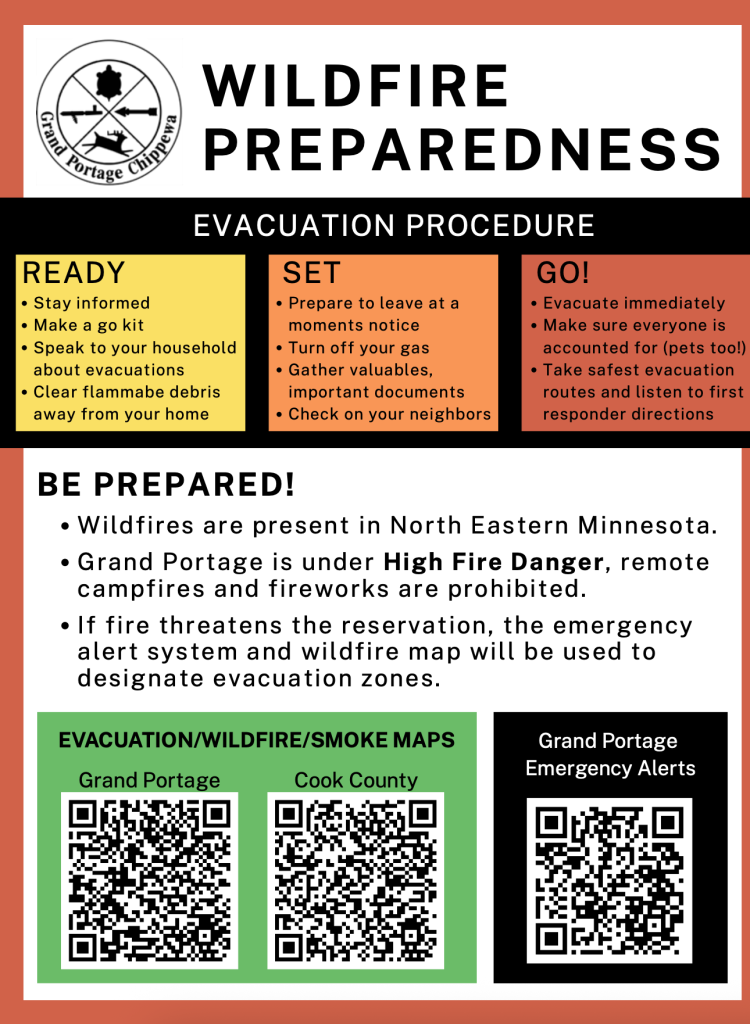
In the unlikely event that an evacuation became necessary, local first responders would go door to door to make sure residents received the message, which is essential in a community where not everyone regularly uses a cell phone or the internet.
Vogel emphasized that Grand Portage’s planning is not limited to wildfires. The Band also has response systems in place for other natural disasters and public-safety emergencies.
“All of that has been absolutely considered for the Grand Portage community,” Vogel said. “There are systems in place to address any of those scenarios too.”
Vogel described Grand Portage as an “incredibly resilient community” because people know their neighbors and are accustomed to looking out for one another. That connection makes it easier to identify who may need help and share information, but it can also allow misinformation to spread quickly.
The recent smoke and fire events have underscored the importance of relying on official sources of information, including the Band’s Facebook page, website and Emergency Alert System, for accurate and timely updates. Enrollment in the alert system more than doubled during the wildfire response, expanding the number of residents who will receive direct notices during future emergencies.
The response has shown how much Grand Portage contributes at home and across the region. For a small community, the Band is deploying significant resources, expertise and leadership. Its firefighters, staff and Tribal leaders are not only protecting the Reservation, but also supporting neighboring communities and helping shape the larger regional response.
Three Ways to Reduce Smoke Exposure
During the recent smoke event, Grand Portage recorded an AQI of 1,271, far beyond the standard scale’s max of 500. Any AQI above 300 is considered hazardous, meaning the smoke can affect everyone’s health.
Wildfire-smoke exposure depends on three things: the concentration of smoke in the air, how heavily you are breathing and how long you are exposed.
Lower the concentration: Stay indoors with windows and doors closed. Use an air purifier or wear a well-fitting N95 mask when outside.
Reduce exertion: Strenuous activity makes you breathe more deeply and take in more smoke. Take it easier when air quality is poor.
Limit your time: Complete necessary outdoor tasks as quickly as possible and return to cleaner indoor air.
•
Keeping Indoor Air Cleaner
• Keep windows and doors closed and seal drafty areas when possible.
• Use a portable air purifier that is appropriately sized for the room.
• Choose a purifier with a HEPA or carbon filter. Avoid models that use ionization, which can produce ozone.
• A box fan fitted with a MERV 13 filter can provide a lower-cost option for filtering smoke.
• Set air conditioners to recirculate so they are not pulling smoky outdoor air inside.
• Follow air-quality updates and guidance from official sources.