
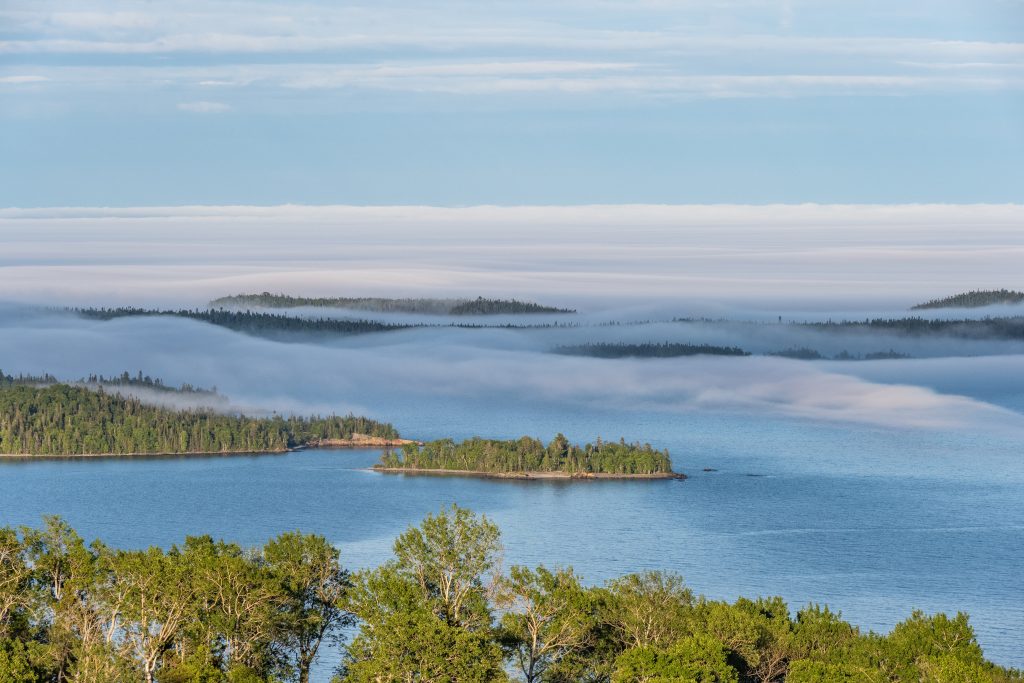
Photo used with permission by ©Travis Novitsky
NEWS RELEASE
Media Contacts: For the Grand Portage Band: haley.brickner@grandportage.com
For the LK Johnson Foundation: etorch@lkjf.org
Map & Images: https://bit.ly/4ssp2sa
GRAND PORTAGE BAND REGAINS HISTORIC TRIBAL LAND: Partnership with the Lloyd K. Johnson Foundation restores ownership of land lost over last 200 years
GRAND PORTAGE, Minn. (March 16, 2026) — The Grand Portage Band of the Minnesota Chippewa Tribe, in partnership with Lloyd K. Johnson Foundation and the Minnesota Land Trust announced today the completed purchase of land that restores to the Band three significant parcels of land that were lost from Band ownership over the last 200 years, marking the largest land return to Grand Portage in recent history.
“The return of this land to Grand Portage is the largest land return in our recent history, and it carries meaning for our Grand Portage families that goes far beyond just acreage,” said Robert Deschampe, Chairman of the Grand Portage Band of Lake Superior Chippewa.
“These three parcels were lost three different ways over 200 years — federal policy, taxation, and outside speculation. Getting them back in a single transfer is something our Grand Portage Members have not seen in our lifetimes. In an era when land acknowledgement statements have become common, this is what reconciliation actually looks like. The Lloyd K. Johnson Foundation has set the new leadership standard when it comes to restorative justice work with Tribes.”
The three parcels of land totaling approximately 87 acres are being returned to the Grand Portage Band through a partnership with the Lloyd K. Johnson Foundation, which made a grant to the Band to acquire the properties from the B. Van Johnson Trust and other family members. The acquisition closed on February 16, 2026.
The acquisition is historically significant because it restores to Band ownership parcels that reflect three different ways in which the Band’s land was lost over the last 200 years:
- Paradise Beach (approx. 5.19 acres) – A stretch of Lake Superior shoreline along Highway 61 south of Grand Portage, a gathering place of deep cultural significance to the Band since time immemorial. This land was lost to the Band as a result of land cessions to the United States in the Treaty of September 30, 1854. Following that Treaty, Paradise Beach was located outside of the Band’s Reservation.
- Francis Island, Susie Islands Archipelago (approx. 1.8 acres)– The Island is part of the historic canoe routes connecting Grand Portage to Minong (Isle Royale), used for fishing, hunting, gathering, and ceremony. The return of the Island continues the restoration of the Susie Islands following the 2017 return of Susie Island from The Nature Conservancy. The Island was lost to the Band when the United States transferred the land to the State of Minnesota as State School Trust Lands.
- Mineral Center Road Forest Parcel (approx. 80 acres) – Forested land approximately five miles west of the Grand Portage community, within the Reservation, supporting hunting, gathering, and traditional stewardship practices. This parcel of pristine and unique forest was lost to the Band through allotment.
The Band entered a treaty with the United States in 1854 that set aside a portion of the Band’s homeland along the North Shore of Lake Superior as its permanent and undisturbed homeland. However, just 20 years later, the federal government changed course, dividing Reservation land and selling it to timber and mining interests, as well as to homesteaders under the General Allotment and Nelson Acts. Throughout the late 19th and early 20th centuries, federal allotment policy systematically dispossessed Minnesota’s Ojibwe people of their lands.
Though titled “An Act for the Relief and Civilization of the Chippewa Indians,” the law was designed to break up communally held tribal lands, relocate the Ojibwe to a single reservation, and open the remaining lands to timber companies, railroads, and white settlers. Many tribal families lost their allotments through unpaid taxes, fraud, and the manipulation of local officials.
The General Allotment Act and federal allotment policies were considered a failure, having failed to break up tribes and having resulted in the impoverishment of tribal people through the greatest land dispossession in American history.
August Van Johnson, who served as Cook County Registrar of Deeds during the early 20th century, had unique access to tax delinquency records, enabling him to acquire a significant portion of Grand Portage and Chippewa City lands during this period, often without money changing hands. His nephew, Lloyd K. Johnson, later served as Cook County Attorney, eventually went into business with his Uncle, and went on to build substantial land holdings across northeastern Minnesota.
Under allotment, individual parcels of land were issued to tribal members in trust, and the remaining unallotted lands were declared “surplus” or “residue” and were placed in the public domain and made available for non-Indian acquisition. While the General Allotment Act was amended by the Burke Act in 1906, which allowed the trust restriction on individual Indian allotments to be lifted before the expiration of 25 years.
The Federal allotment policy was disastrous for tribes and their members. While it resulted in the impoverishment of Indians and represented one of the greatest legally sanctioned dispossessions of land in modern history, it failed to break up tribes. In 1934, as the failures of the allotment policy were laid bare by the Report of Lewis Merriam, “The Problem of Indian Administration,” Johns Hopkins Press (Baltimore: 1928) (Merriam Report), the United States turned fully away from its former policy, and a new period of supporting tribal sovereignty and self-governance began. The legislative cornerstones of this change were the Wheeler-Howard Indian Reorganization Act of 1934 (IRA).
While some land was restored to the Band under the Indian Reorganization Act, control of a significant number of parcels on the Reservation remained in the hands of non-Indian owners. The Band has been dedicated for decades to restoring these parcels to tribal ownership. The effort could not happen overnight, since the Band was compelled first to acquire the lands in fee from the non-Indian owners and then request that the United States agree to hold them in trust for the Band, which is a process that is both expensive and time-consuming, especially where available Band resources are dedicated to delivering governmental services to its members.
Starting in late 2024, the Foundation began working with the Band, the owner of the land, the B. Van Johnson Trust, and the Minnesota Land Trust to arrange the acquisition of the land by the Band, which was an important goal for the B. Van Johnson Trust:
David Berner, representing the B. Van Johnson Trust, said the trust and other Johnson family members felt strongly that the land should return to the people with the deepest historical and cultural connection to it. “Our family recognized how meaningful this land is to the Grand Portage Band, and we are grateful to have worked together with the Grand Portage Band, the Lloyd K. Johnson Foundation, and the Minnesota Land Trust to make this return possible.”
The Foundation then voted unanimously to approve a grant to the Band to acquire the land directly from the Trust. The grant marked the single largest grant the Foundation had made, representing an unprecedented commitment both to the Bands’ land restoration efforts and to amending the historical relationship between the Band and the family:
“The Foundation has put significant effort into understanding the history and impacts of Mr. Johnson and his family’s business dealings along the North Shore,” stated Erik Torch, Foundation Executive Director. “We have worked to build a relationship with the Grand Portage Band and to support their goals for their people and nation. This land return is an important chapter in what we hope will be a long and positive partnership. The Foundation is grateful to the Johnson Family for their willingness to return this land, and to the Minnesota Land Trust for their critical help in this effort.”
“Nothing can undo what happened to our Grand Portage families over the past 200 years,” said Chairman Deschampe. “But returning these lands to the Band is very meaningful — for our ancestors, for our people today, and for the generations who will care for and keep these lands pristine after us. We are grateful to the Lloyd K. Johnson Foundation, the Minnesota Land Trust, and the B Van Johnson Trust for making this happen.”
The Lloyd K. Johnson Foundation is a private, independent foundation established in 1975 that works to expand opportunities for people and communities on the North Shore of Lake Superior. The Foundation does this through intentional giving, a commitment to place, and by working with people to make this region and its future better for everyone. The Foundation provides grants serving Minnesota’s North Shore as well as a scholarship program for Cook County High School. To date, the Foundation has provided over $21 million in grants and over $1.3 million in scholarships. The Foundation does not have any formal or informal connections with the Johnson family.
Gichi-Onigaming, the Grand Portage Band of Lake Superior Chippewa, is a sovereign, self-governing federally recognized American Indian tribal government located in the most northeastern corner of Minnesota, approximately 150 miles from Duluth. It is bordered on the north by Canada, on the south and east by Lake Superior, and on the west by Grand Portage State Forest. The Grand Portage Band is a signatory to the Treaty of LaPointe of 1854.