
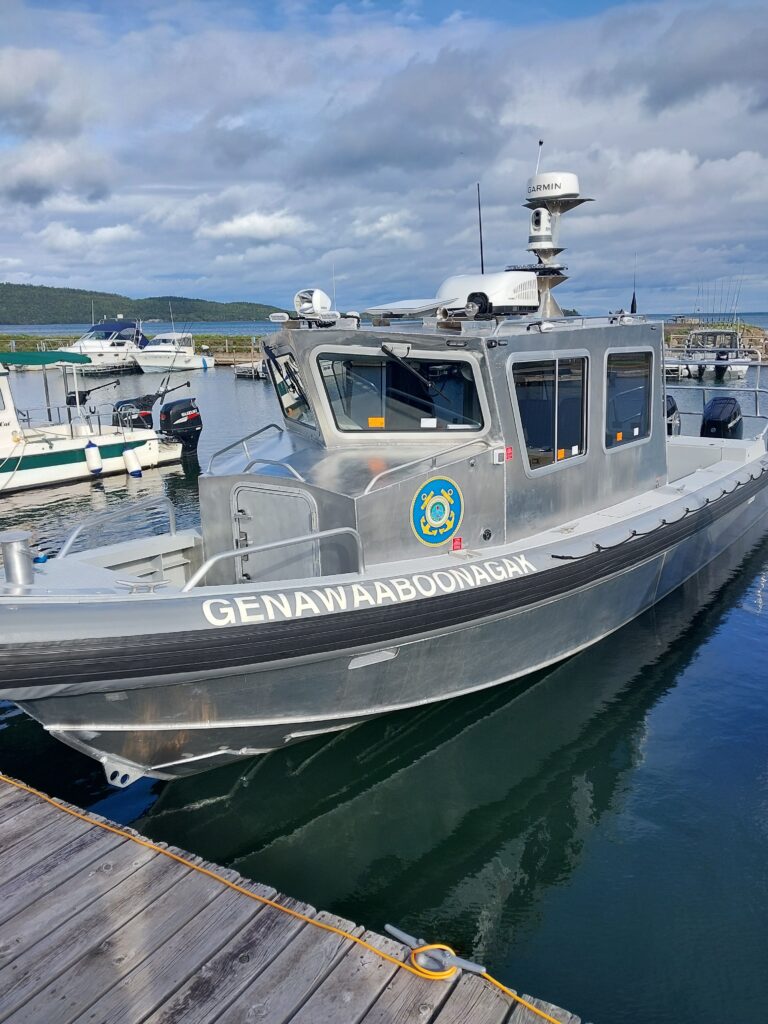
The Grand Portage Band of Lake Superior Chippewa launched the nation’s first Indigenous Coast Guard into action this past Saturday, when its newly delivered vessel was used in a successful rescue just 18 hours after arriving in port. The operation marked the beginning of a program years in the making that enhances marine safety on Lake Superior.
The program is called Genawaaboonagak, an Ojibwe word that means “keeping watch while on the water.” The name captures both the responsibility of protecting those on the lake and the sovereignty behind creating an Indigenous Coast Guard.
The initiative began when the U.S. Coast Guard station in Grand Marais closed in 2022. The Grand Portage Tribal Council, led by Chairman Bobby Deschampe, raised concerns about the gap in rescue capability. “Marine safety is a serious concern for us,” Deschampe testified to the Minnesota Legislature, describing the safety risks to recreational boaters and Tribal subsistence and commercial fishermen without any government rescue capability in the region. That testimony, combined with collaboration between the Tribe and county leaders, led to $3 million in state bonding dollars. Dr. Seth Moore, Director of Natural Resources for the Grand Portage Band, explained that they drafted language into the state bonding bill to ensure funding for the creation of the Indigenous Coast Guard.
With that funding, Grand Portage worked with the Cook County and Lake County Sheriff’s departments to design a regional rescue plan. Four custom vessels were commissioned from Lake Assault Boats in Duluth, with Grand Portage keeping two and gifting one each to Cook and Lake counties. The agencies agreed to staff the vessels from May through November to provide marine patrols, safety checks, and aquatic rescues.
The first vessel, delivered Friday, is a 34-foot rigid hull inflatable boat with a total length of 39 feet. It is powered by twin 350-horsepower motors and equipped with GPS, radar, sonar, thermal and video imaging, autopilot, spotlights, sirens, and a tow reel. Fully loaded, it can travel at more than 50 miles per hour. The second vessel will be delivered in November.
Grand Portage is now building a marine rescue core team to crew the vessels, with members pursuing captain’s licenses, formal search and rescue training, and regular drills to enhance their capabilities. As a new and developing program, these steps are laying the foundation for long-term readiness.
In addition to Dr. Moore, current members include Roger Deschampe, Jr., Lead Natural Resources Technician; Bob Vogel, Chief Conservation Officer; Jeremy Vogel, Conservation Officer; Ryan Grow, Senior Fisheries Biologist; Ruth Vogel, Tribal Emergency Manager; and Joe Deschampe, Grand Portage Marina Director. Cook and Lake counties have also identified staff for their vessels.
“Grand Portage has dealt with up to 10 aquatic rescues per year for a very long time,” said Moore, who has been part of many of those operations. “It’s amazing to see the Grand Portage Band continue leading its long term commitment to Lake Superior safety. This program is increasing marine safety along the entire North Shore from Duluth to the Canadian border.”
The new program was tested almost immediately. Less than 18 hours after delivery of the new vessel, Minong (Isle Royale National Park) Chief of Natural Resources reported a vessel disabled between Grand Portage and Isle Royale. Within an hour of receiving the call, the Grand Portage team was on the water in five- to seven-foot waves and gusty winds. After correcting for wrong coordinates, they located the 25-foot Sea Ray Serenity with four people aboard. The boat’s engine ran, but a broken linkage prevented propulsion. They towed the vessel 14 miles through heavy seas at just four miles per hour to avoid damage, bringing everyone back safely. This rescue was a real-life test of their new capability, and it showed why this program matters.
The Grand Portage Band of Lake Superior Chippewa takes pride in creating the first-ever Indigenous Coast Guard. With no precedent to follow, the program is being built step by step, establishing its own framework for training and operations. Genawaaboonagak embodies Tribal leadership in action while providing a vital safety service for the entire North Shore.