
September 23, 2026
Tribal leaders say Minntac shows why Minnesota must understand the cumulative effects of extraction before approving new copper-nickel mines and other extraction projects in the 1854 Treaty Territory
GRAND PORTAGE, Minn. — The Bois Forte Band of Chippewa and Grand Portage Band of Lake Superior Chippewa today announced they will formally request the Minnesota Environmental Quality Board to order a comprehensive study of the cumulative effects of mining and other extraction across the 1854 Treaty Ceded Territory — approximately 5.5 million acres encompassing all of Cook and Lake counties, most of St. Louis and Carlton counties, and small portions of northern Pine and east-central Aitkin counties.
As Minnesota considers a flood of new extraction applications, including several copper-nickel mines, the Bands are also calling on the Governor and state agencies to temporarily refrain from approving new extraction permit applications within the territory until the study is completed and the affected Tribal Nations have been meaningfully consulted about the results.
Their message to Minnesota is: understand what generations of extraction have already done to these waters before authorizing more. The Bands say U.S. Steel’s Minntac mine demonstrates why.
Minntac: 45 years to comply, 18 years of projected mine life
The Minnesota Pollution Control Agency is proposing to give U.S. Steel as long as 45 years — until approximately 2071 — to meet certain final sulfate limits at its Minntac tailings basin.
At the same time, U.S. Steel is seeking federal approval to expand the Minntac mine pit. A July 1 U.S. Army Corps of Engineers public notice states that if the expansion is approved, U.S. Steel is predicting the life of the Minntac mine would extend only to 2044.
That means MPCA is proposing a pollution-control timetable that could extend roughly 27 years beyond the mine’s own projected operating life.
“The mine could be gone for nearly three decades before the deadline arrives. Minnesotans deserve to know how that can possibly qualify as compliance ‘as soon as possible.’” said Grand Portage Chairman Robert Deschampe.
Federal law limits an individual NPDES permit term to no more than five years. A compliance schedule can extend beyond one permit term, but federal requirements call for compliance as soon as possible and require enforceable interim steps. The proposed Minntac timetable could span roughly nine five-year permit terms before certain final sulfate limits are reached.
For the Bands, what makes that especially troubling is the history that came before it.
Sulfate has been identified as a pollutant of concern at the Minntac tailings basin since at least 1987. MPCA warned U.S. Steel about elevated sulfate in surrounding waters in 2000. Court records show Minntac was out of compliance with certain sulfate-related permit requirements by 2004, followed by a series of compliance schedules intended to reduce sulfate pollution.
The 2018 Minntac permit then required U.S. Steel to meet a 250-milligram-per-liter groundwater sulfate limit at the property boundary by December 31, 2025. U.S. Steel challenged MPCA’s authority to impose that groundwater standard, but the Minnesota Supreme Court ultimately upheld MPCA’s authority.
The December 2025 compliance deadline was not met. The new draft permit now proposes allowing as many as 45 additional years before certain final sulfate limits are achieved.
“Minnesotans should be asking why missing a pollution deadline results in more time —potentially another 45 years,” said Deschampe. “At some point, extending the deadline stops looking like enforcement and starts looking like a reward for delay.”
Bands: Pollution control should be part of the cost of doing business
The Bands also reject the premise that meaningful sulfate reduction should be pushed into another generation because pollution-control technology requires substantial investment.
U.S. Steel is now owned by Nippon Steel, which says it plans approximately $11 billion in capital investment in U.S. Steel facilities by the end of 2028. As of August, Nippon reported that approximately $3.7 billion in U.S. Steel projects had already been approved. Those investments are company-wide and are not specifically designated for Minntac pollution controls.
“This is not a company without access to capital,” said Bois Forte Chairman Carlos Hernandez. “Pollution control should be part of the cost of doing business. Minnesota should be requiring investment in technology that reduces this pollution while the mine is operating and producing revenue — not writing a deadline that extends decades beyond when the mine closes.”
The 1854 Treaty Authority resolution calls for the shortest reasonable, scientifically supportable treatment schedule, active treatment on both sides of the tailings basin, enforceable interim pollution-reduction milestones and adequate financial assurance if treatment obligations extend beyond the mine’s operating life.
The Urgency of Studying the whole picture
The Bands say this is about much more than one mine. Minnesota is now considering another generation of extraction in northeastern Minnesota, including proposed copper-nickel mining. The State’s own environmental review of the NorthMet copper-nickel project recognizes that sulfide minerals in waste rock, exposed pit walls and tailings can release sulfate when exposed to water and oxygen if those releases are not controlled. The review specifically identified sulfate as important because wild-rice waters lie downstream.
NewRange Copper Nickel is now proposing significant changes to NorthMet, including increased ore production and a different tailings-management approach, and DNR is determining what additional environmental review is required.
For Bois Forte and Grand Portage, that creates an obvious question:
If Minnesota has spent decades struggling to bring sulfate pollution from existing taconite mining into compliance, should the State authorize new forms of mining capable of creating additional sulfate impacts before it knows the cumulative burden the region’s waters already carry?
“Minntac is the clearest example of why Minnesota needs to stop looking at these projects one permit at a time,” Deschampe said. “We have spent decades arguing about sulfate from individual tailings basins, and now the State is considering new copper-nickel mines in the same treaty territory. Before the State authorizes more sulfate pollution, it needs to understand what generations of mining have already done to these waters.”
A state process designed for cumulative problems
The Bands are calling upon the Environmental Quality Board to order a Generic Environmental Impact Statement, or GEIS, examining the cumulative effects of mining, mineral and gas exploration, and related extraction activity across the 1854 Treaty Ceded Territory and environmentally connected watersheds.
Minnesota created the GEIS process specifically for environmental questions that cannot be adequately understood project by project. State rules provide that the EQB may order a GEIS for “types of projects that are not adequately reviewed on a case-by-case basis.” The GEIS is a tool the State has only used twice before; once for timber and once for animal agriculture.
The proposed study would establish existing environmental conditions and examine the combined effects of past extraction, existing operations, projects now proposed and reasonably foreseeable future development. The Bands are calling for it to examine sulfate, mercury and methylmercury, wetlands, surface- and groundwater hydrology, mine dewatering, tailings and waste rock, air deposition, habitat alteration and the long-term sustainability of treaty-protected resources.
“Wild Rice and fish don’t know where one permit ends and another begins,” Hernandez said. “The State divides these impacts into individual projects but nature doesn’t. That’s why we need the State to study the whole picture before it approves projects that will add more sulfate pollution.”
Treaty rights make the Bands more than stakeholders
Bois Forte and Grand Portage emphasized that they are not approaching the State simply as environmental organizations or interested members of the public.
They are sovereign Tribal governments whose members retain treaty-reserved rights to hunt, fish and gather throughout the 1854 Treaty Ceded Territory. Minnesota law expressly recognizes the 1854 Treaty Area Agreement addressing those harvesting rights.
Through the 1854 Treaty Authority, the Bands carry out fisheries and wildlife management, water-quality and wild rice monitoring, habitat programs and conservation responsibilities throughout the ceded territory.
Minnesota Statutes § 10.65 also requires state agencies, including MPCA and DNR, to engage affected Tribal governments in timely and meaningful government-to-government consultation on matters with Tribal implications. The statute requires agencies to proactively seek Tribal input, treat Tribal interests as an integral part of decision-making and consider the information received through consultation.
“We are not another stakeholder asking the State for a favor,” Deschampe said. “We are Tribal governments with legal rights to harvest resources throughout this territory. The State has a statutory duty to consult us when its decisions affect those rights — and those rights mean very little if there are no healthy resources left to harvest.”
That connection is particularly visible in wild rice and fish.
Minnesota’s 10 mg/L sulfate standard for wild-rice waters has existed since 1973. Sulfate can harm wild rice and, under appropriate environmental conditions, promote the bacterial conversion of mercury into methylmercury, the form that accumulates in fish. Fish advisories are
The MPCA engaged in multiple consultations with the Bands, and the draft permit improved because of Tribal input. The Bands are calling for preservation of the improvements, but requiring a much shorter compliance period.
“We are co-stewards of the resources, and the State has a statutory duty to consult us when its decisions affect our harvesting rights,” said Grand Portage Secretary-Treasurer April McCormick. “The State has the regulatory authority to ensure no one is above the law. Manoomin (wild rice) is in crisis and disappearing from our waters because of decades of pollution that the regulators are allowing. What do our treaty rights mean to us if we can’t eat the fish and the manoomin is gone?”
“Our ancestors didn’t reserve the right to catch-and-release. They reserved the right to feed their families,” said McCormick.
A GEIS would not itself stop existing mines or replace environmental review for individual projects.
The Bands are separately calling upon the Governor and state permitting agencies to temporarily refrain from approving new extraction permit applications within the study area until the cumulative study is complete. The findings of the study can inform future decisions and affected Tribal governments have been meaningfully consulted.
Existing mines and businesses would continue operating.
“We are not asking Minnesota to shut anything down,” Deschampe said. “We know how important mining is to this region. We are saying: know what is already in these waters before approving what comes next. Study the whole picture first. Then make the decisions.”
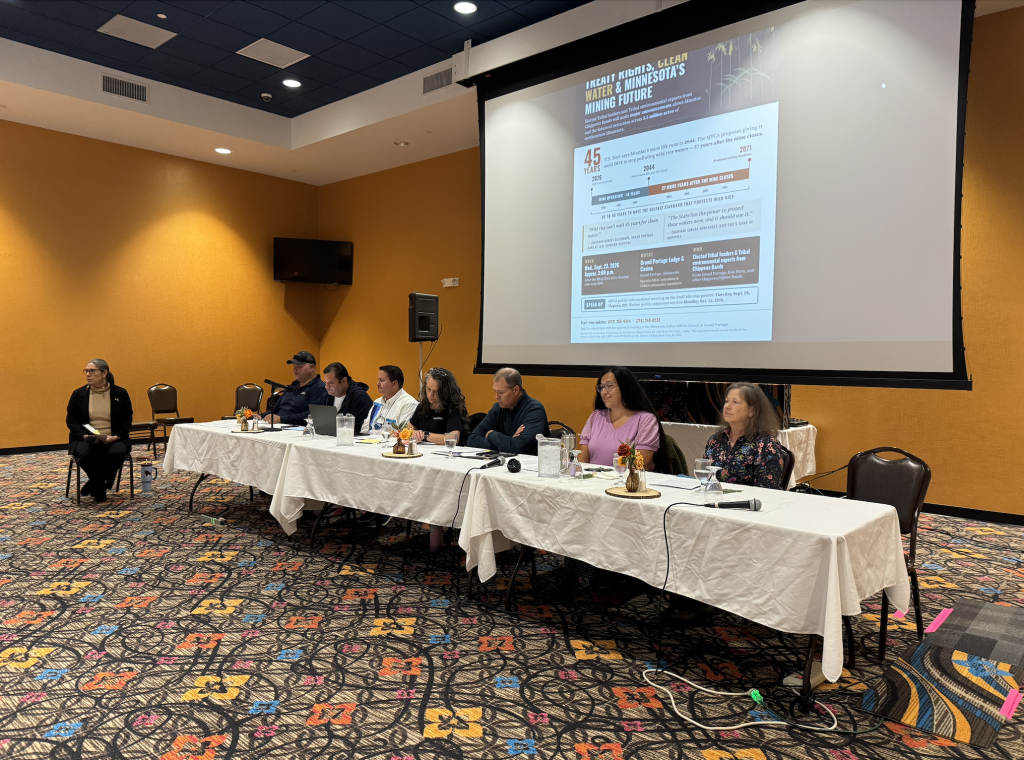
The Bands’ action will be discussed today during a Tribal Leaders Panel at Grand Portage held in conjunction with the Minnesota Indian Affairs Council meeting.
MPCA’s draft Minntac wastewater permit is open for public comment through October 12, 2026, and MPCA will hold a public informational meeting September 29 in Virginia.
About the 1854 Treaty Ceded Territory
The 1854 Treaty Ceded Territory covers approximately 5.5 million acres across six northeastern Minnesota counties — all of Cook and Lake counties, most of St. Louis and Carlton counties, the northern portion of Pine County and a small portion of east-central Aitkin County.
Under the Treaty of LaPointe of 1854, the Grand Portage, Bois Forte and Fond du Lac Bands reserved rights to hunt, fish and gather throughout the ceded lands.
Media Contacts
Haley Brickner (612) 355-9344
Emily Johnson (218) 349-0233